Home | Books | Cards | About | Contact and Postage | Mailing List and Links
Rare Triumphs tarot - the trump cards
The trump cards in the Rare Triumphs are suitable for an "alternative old-style" tarot. The trump sequence essentially follows the Marseille sequence, and the cards are drawn in the art style of the Marseille tarot, but the imagery on the trump cards is different from the typical Marseille imagery, and sometimes the names are also different from the names on the Marseille cards.
The trump suit in the Rare Triumphs is not a recreation of any particular historical tarot, but rather an interpretation, reached by looking at the earliest days of tarot, and looking at how different early tarot traditions developed.
When the game of tarot was invented, the trump suit was added to the ordinary Italian playing cards to create a superpack of cards that could be used for the game of triumphs, as it was called at the time. The motifs represented by the cards of the trump suit were chosen to form a sequence of great significance, an allegorical, philosophical, religious sequence about the way we live our lives.
Different regional variations of the sequence of the tarot trumps appeared. The Marseille sequence is one of these, but there were others, and two of these are still in general use in Italian regional tarots: the Bolognese and Sicilian sequences. Note that apart from the widely varying positioning of the three virtues, the rest of the trump sequence remains broadly conserved throughout all these regional variations. The sequence can be divided into three parts: the lowest (0-5), the middle (6-14), and the high (15-21). These three parts of the traditional trump sequence might be described as being related to, respectively, the earthly domain, the way we live our lives, and a spiritual ascent. From my description below of the Rare Triumphs trump sequence, you may hopefully see how it fits in with with the broader historical universal tarot sequence.
***
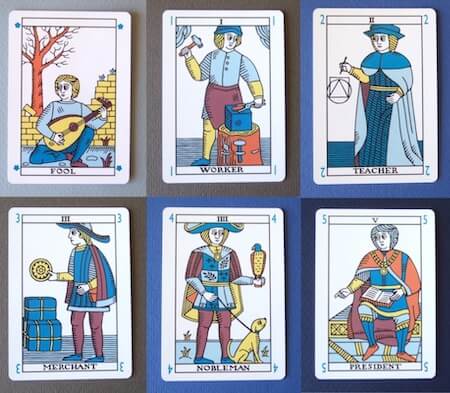
The biggest real changes in the trump cards of the Rare Triumphs are at trumps 2-5, which in the usual tarot sequence are the "popes and emperors" cards, but which I have completely replaced with a series based on the states of man on earth, as seen in the so-called "Mantegna tarocchi". The "popes and emperors" have been replaced before, partly or completely, in historical regional tarots: for example, in the Bolognese tarot (all replaced by moors), in the Besancon tarot (the popes replaced by the Roman gods Jupiter and Juno), and in the Brussels-Rouen tarot (the popes replaced by the Roman god Bacchus and the Spanish Captain from the Commedia dell'Arte).
Beyond that, most of the names and much of the imagery come directly from older (especially Italian) tarot cards, and everything fits in with the historical sequence of the tarot trumps. Some specific influences on the card imagery in the Rare Triumphs trump suit include: The Vieville tarot (Paris, ca 1650). The anonymous Parisian tarot (ca 1650). Mitelli's tarocchini and "Gioco di Passatempo" cards (Italy, 1634-1718). The so-called "Mantegna tarocchi" (Italy, 15th century). Bolognese tarocchini (ca 1500 - present day). Florentine minchiate (ca 16th-20th century). French minchiate (ca 1650). Sicilian tarot (ca 17th century - present day). Luxury hand-painted tarots: Ercole d'Este tarot, "Charles VI" tarot, Alessandro Sforza tarot (Italy, ca 15th century).
***
So the Rare Triumphs trump sequence is as follows:
The first section of the sequence (0-5, including the Fool) represents the states of man on earth. The way I have represented this in the Rare Triumphs is as a heirarchy of sorts, related to the "states of man" series of images in the "Mantegna tarocchi", and involves a complete substitution of the "Popes and Emperors". But even the Popes and Emperors in the traditional tarot sequence are representative of the earthly domain.
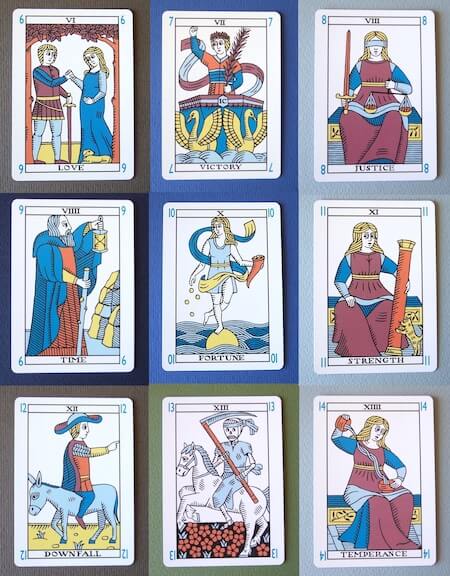
The next section of the sequence (6-14) represents allegories of what we might encounter in life, interspersed with three virtues under whose influence we may choose to live (Strength, Justice, and Temperance). First, the good things: Love and Victory; second, bringers of change, for better or worse: Time and Fortune; third, ultimately, Downfall and Death.
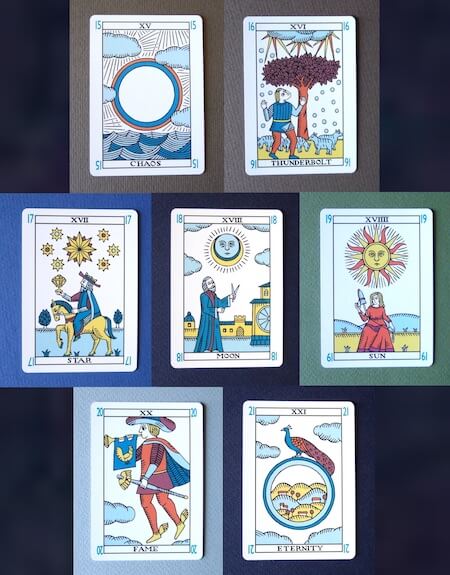
The final section of the sequence (15-21) represents an ascent. Starting from a position of ultimate darkness, Chaos, there comes a series of brightening lights through Lightning, Star, Moon, and Sun. The highest two trumps, Fame and Eternity, are also the names of the highest two triumphs in Petrarch's Triumphs poem.
Back to the main Rare Triumphs page here.